A trip down to London for this one - Profeet in Fulham, which Andy's trusted since 2005 and actually worked at for seven years. They've been doing proper biomechanical shoe fitting since the early 2000s, and he still represents them as an ambassador now.
The 3D analysis
I ran on a treadmill at two speeds - an easy one around my LT1 pace, then a faster one around 13.5km/h - while their 3D motion capture picked apart stride length, cadence, vertical oscillation, and the cyclical motion through each stride: knee bend, hip extension, hamstring activation, where my foot actually lands. There was a clear left-right difference, which lined up with something the physio had already flagged a few weeks earlier, so at least that wasn't a surprise. What was more interesting was how much I was bouncing vertically rather than driving forward - and at the faster speed, that vertical oscillation actually got worse, not better. Energy going up and down instead of along.
The shoes and the insoles
Then onto what I'd actually been running in. My current trainers were too soft for what I need right now - not supportive enough, especially with limited mobility in my right big toe throwing off how evenly I load each foot. We tried a few neutral options and landed on a firmer pair with better heel support, plus a pair of Brooks Hyperion to race in.
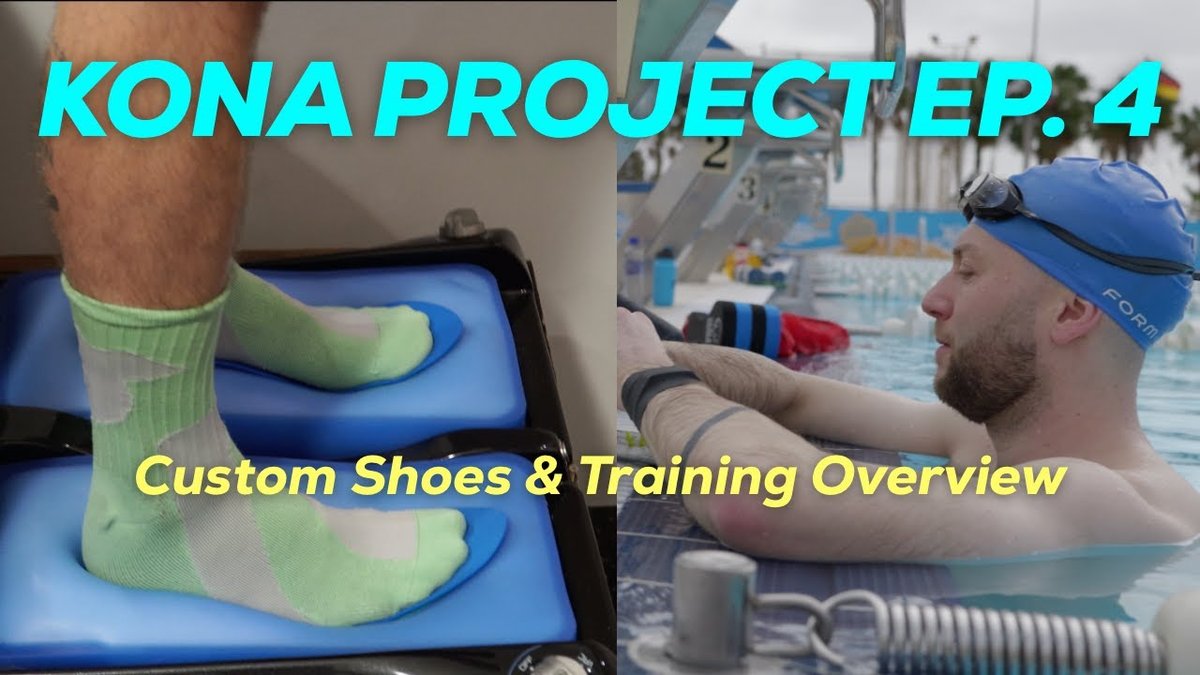
The genuinely new part was the insoles - heat-molded to my actual foot shape while standing on them under load, using the foot's own natural arch mechanism rather than anything forced. Ten minutes to cool and set, then trimmed to fit the shoes. They felt strange stepping into them the first time, in a good way - properly supportive somewhere I didn't know I needed it.
Andy's wider point stuck with me: a lot of triathletes race Ironmans in whatever soft, cushioned shoe is newest, with feet rolling and turning out that they've never actually seen on video. Add a stiff carbon racing shoe on top of that, seven-plus hours into the day when you're already fatigued, and it adds up. Doesn't have to be Profeet specifically - just get an actual video gait analysis from someone who knows what they're looking at.
How training's actually gone
Quick update on the six weeks since the lab testing: the plan is an Ironman in Estonia in August - flat, and explicitly a test of the year's work rather than a qualification attempt. February was swim-technique heavy, working through fundamentals that needed addressing; March has shifted into longer aerobic sets with the drills kept to the warm-up instead of the main set. On the bike we're deliberately building tolerance - more volume, more time at a comfortable aerobic effort - before any real VO2 max block, since there's no rush to start that yet. Running's still being held back a little given how close my two thresholds already sit together, just some 30-second efforts sprinkled in to keep some leg speed and start waking up the posterior chain the run analysis flagged.
All in, training's settled around 14 to 15 hours a week - deliberately capped given I've got a full-time job, with rest days built in on purpose rather than as an afterthought. Next up: a training weekend together at the end of March, then a half Ironman in Bolton in June as a dress rehearsal before Estonia.