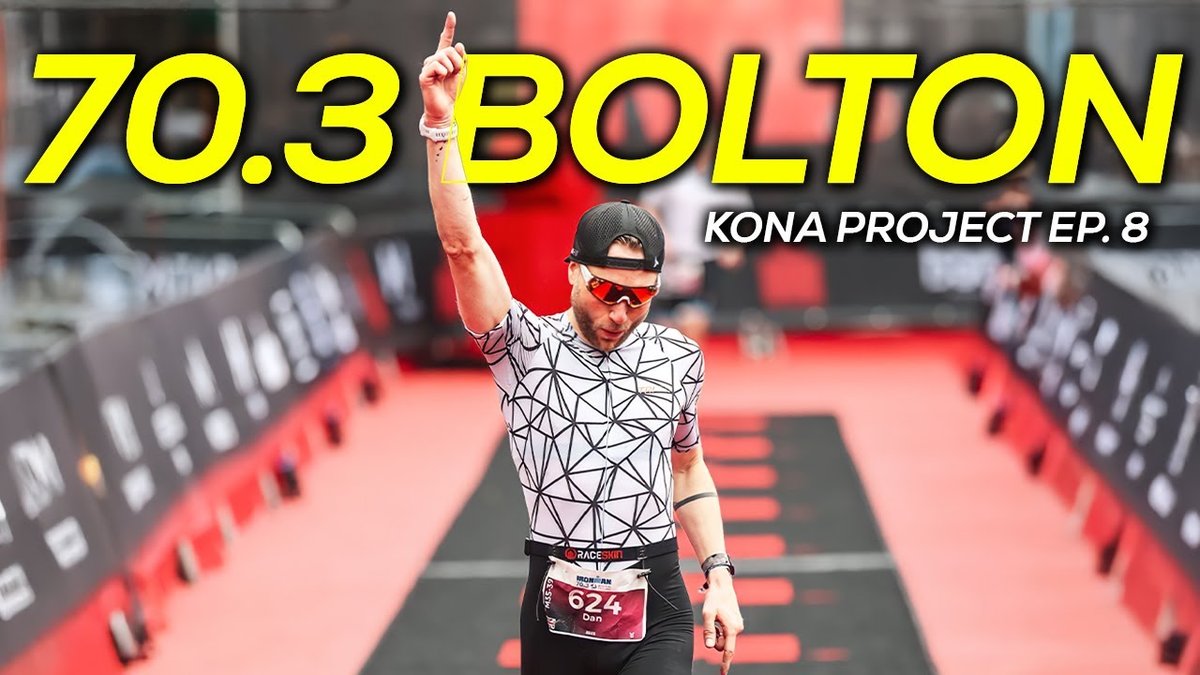
Six months into this now, and this race genuinely earned its own episode rather than being folded into a training update. Not because of the result on paper - 5:25:40 - but because of everything that happened to get there.
The week that nearly ended it before it started
Wednesday night of race week, entirely my own doing: food poisoning. It wiped me out completely through Thursday - sick through the early hours, sleeping in two and three hour blocks, a full day off work and training. At the lowest point I genuinely wondered if I'd even make the start line, and whether I'd be disappointed in myself for causing it. The anxiety fed itself for a while, but I stayed as resilient as I could, focused on rest and hydration, and trusted the months of training underneath it.
Friday was the turning point - solids back, feeling more like myself, and getting into the logistics and excitement of race weekend helped take my mind off it. By Friday evening I was properly bouncing back, even if the carb-loading plan had to be scaled back from around 500g to closer to 400g a day, easing my gut back in with a sports drink rather than forcing solids I wasn't ready for.
The swim
Race morning: soaked oats, a spoon of nut butter, coffee, a 3:30am start. I skipped my usual pre-race gel since I still felt off - the right call. A rolling start, four at a time, seeded myself near the front of the 30-32 minute group, dove off the pontoon, and eased into it rather than chasing anyone early. Sighting off frequent yellow buoys made the outward leg easy; the crossing got choppy, and the sun came out directly in my eyes on the way back in, right as I was picking off a lot of backmarkers. Covered in weeds by the end, but 35 minutes - exactly on plan.
The bike - and the mechanical
T1 took 6 minutes against the quick age-groupers' 3 to 4 - a clear, practiced area to find free time. The bike itself is two flat, technical loops around Pennington Flash before a longer, exposed stretch out toward Bolton and back - properly windy, a few people called it a wind tunnel. I'd ridden most of the course twice in the weeks before, which meant knowing exactly where I could stay in aero through the bends and where I actually needed to slow down, a real edge over people seeing it cold.
The climb near the turnaround went fine first time through - I knew it was five or six minutes, paced it with a planned recovery, and flew down the technical descent after, just careful at the very top where the earlier rain had left it muddy. Second loop started the same way, until about 70km in: a crank bolt popped out mid-descent and the chain locked solid around it. Thankfully it happened going downhill rather than at speed on the flat, so I could brake and pull over safely rather than coming off.
A race marshal - Marshal 410, never got his name - helped me get the bolt back in and the chain untangled. Seven minutes lost on the spot, and the chain then came off another five times climbing the same hill again, each one meaning a dead stop on a steep gradient and a restart from nothing. At that point I genuinely thought the race was over. I've never DNF'd, and for a while I assumed this would be the first time. The bike held together just long enough to get me through the final few kilometres to T2.
The run
Then the part that made no sense until the debrief explained it: I felt nauseous through the entire bike and run, despite sticking to exactly the fuelling strategy I'd practiced for weeks. It wasn't the nutrition - it was the tail end of the illness still working through my system. Every gel felt like it might come straight back up.
Somehow the legs didn't know that. Out around 4:00-4:10/km through the early crowds, settling to roughly 4:10-4:20, slower on the long gradual climbs, properly quick again on the descents. Second lap brought torrential rain - everyone finished soaked. 1:34 for the half marathon off the bike, which is a genuinely good time in a 70.3, and one I didn't think I had in me feeling the way I did. Emotional finish, and my coach, partner, and friends were all there at the line.
What it actually showed
The debrief afterwards reframed the whole day for me. A hard race already causes real inflammation through the gut and muscles - that's normal and temporary. What I'd layered on top was the inflammation from being properly ill two days earlier, which takes 48 to 72 hours to clear, stacked straight on top of race-day stress. Looking at the file afterwards: normalised power around 179-180W, roughly 73% of threshold - genuinely controlled given the circumstances, not a maximal effort gone wrong. The mechanical alone cost somewhere around 15 to 20 minutes.
None of that is an excuse for a slow day - it's the actual physiology behind why a day can go sideways even when the training underneath it is completely real. The work was there. The evidence of six months of consistency doesn't disappear because one day had food poisoning and a broken bike in it.
What's next
New bike already sorted - a proper TT build to replace the 10-year old bike that's clearly done its time. No changes needed to the fuelling strategy itself, since it worked fine until my gut simply wasn't cooperating. And a surprise from Andy: a low-key, non-branded half-Ironman-distance race in the Cotswolds in a few weeks, deliberately timed before our next training camp - not for a time this time, just one more smooth, controlled dress rehearsal before Ironman Tallinn in August.